
Add products by adding codes
All About BMW M57, M57N and M57N2 engines - tuning, swaps, faults
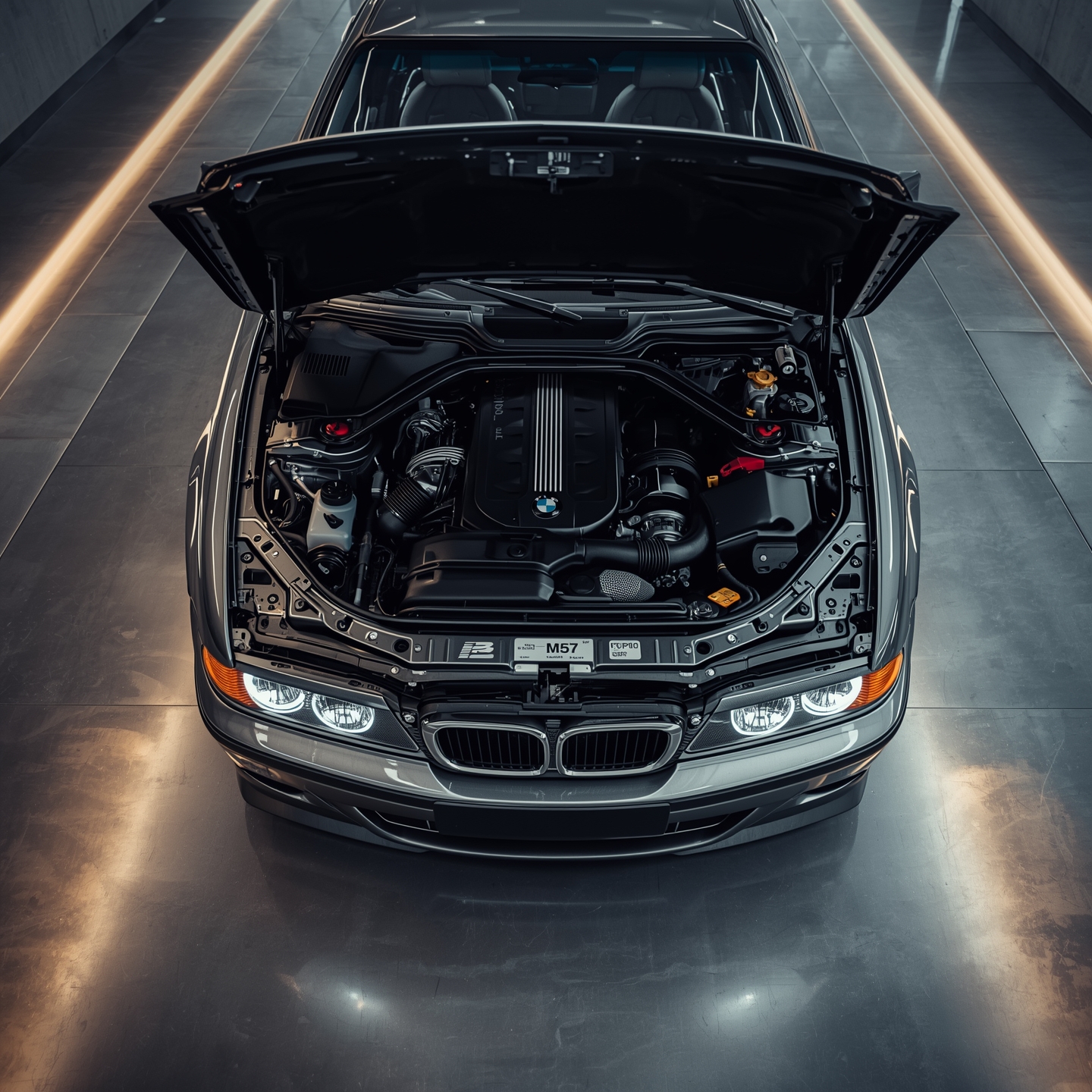
In the world of automotive enthusiasts looking for a solid diesel unit for tuning or a swap, the topic "everything about BMW M57 and M57N engines" has invariably returned for years. And it is no wonder – it is a design that, thanks to its durability, power potential, and parts availability, is deservedly considered one of the best in BMW's history.
This guide answers the most common questions: which M57 variant to choose? How does the M57N differ from the M57N2? Is it possible to swap it into an E36 or maybe a Patrol without issues? And most importantly – how much power can realistically be extracted without risking the engine?
Where did the M57 engine come from?
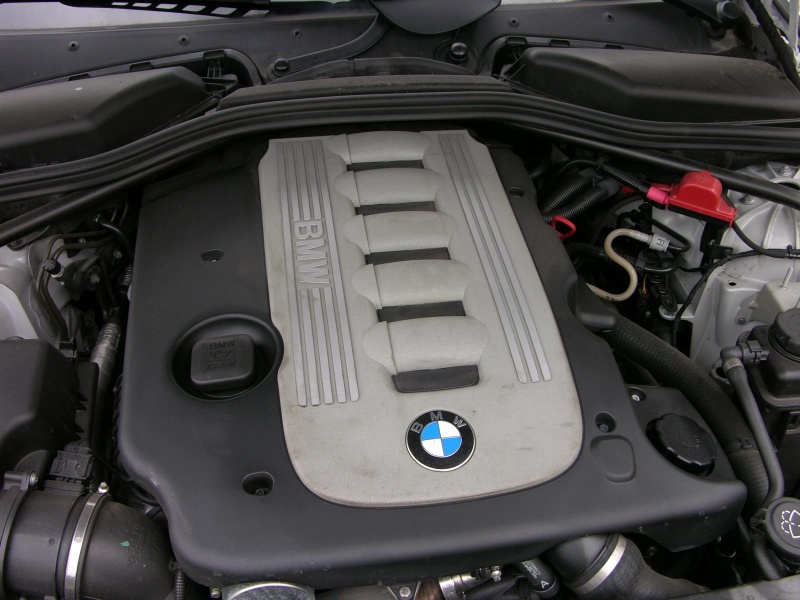
The M57 engine was developed by BMW as the successor to the older M51 and was intended from the start to meet growing customer demands and emission standards. Debuting in 1998 in the E39 530d model, this unit combined high refinement with very good performance and fuel economy. The M57 was structurally modern for its time – it used a cast-iron block, an aluminum head, a first-generation Common Rail system, and a turbocharger with variable vane geometry.
This engine was successively developed. In 2003, the M57N version appeared, also known as the M57TÜ (Technische Überarbeitung – technical revision), which introduced several significant changes: new injectors, stronger fuel pumps, and a modified turbocharger.
The modernization also covered the 2.5-liter versions, so-called 25d, which appeared in the BMW E60, E90, and X3 E83. Although less common in tuning projects, the 25d versions (with a displacement of 2497 cm³) were offered with a single turbo and power outputs of 163–177 HP, providing great flexibility and low fuel consumption.
The last and most advanced version – M57N2 – entered production in 2005. An aluminum block (about 20kg lighter than the cast iron one), a modified cooling system, piezoelectric injectors, and electronically controlled turbochargers were used here. These engines were installed in models such as the E60 535d, E70 X5 3.0sd, or E90 330d LCI. These units offered power up to 286 HP and torque reaching 580 Nm – while maintaining the durability known from previous versions.
How do the M57, M57N, and M57N2 versions differ?
Understanding the structural differences between M57 versions is key to making a conscious choice of the power unit – both for a swap and for tuning. At first glance, all engines in this series look similar. However, in practice, the differences concern almost every key component: from the engine block, through the accessories, to the electronics.
M57, the first generation, used a massive cast-iron block that provided great resistance to high combustion pressures. These engines had a common rail system with a CP1 pump, Bosch 047 electromagnetic injectors, and a GT2256V turbocharger (and in newer TÜ GT2260V variants) controlled by vacuum. Despite their simplicity, these units could withstand heavy loads and were eagerly used for conversions in light off-road vehicles and the BMW E36/E46.
The M57N version is a serious step forward – a new type of pump (Bosch CP3 R90), Bosch 131 and 216 injectors, a modified intake manifold, and newer versions of higher-efficiency turbochargers. The EGR system and recirculated exhaust gas cooling were also changed. It is worth noting that the 25d versions in this generation also used similar accessories, but had different ECU maps and a weaker turbo, which affects tuning possibilities.
The most advanced design is the M57N2. This version offered both single turbo (231–245 HP) and biturbo (272–286 HP). Key differences include: an aluminum block (20kg lighter, but less resistant to extreme loads), piezoelectric injectors, modern turbocharger control, and a different type of sensors (MAP, exhaust gas temperature). In tuning practice, the iron-block M57/M57N is more often chosen for very high power outputs (500+ HP), while the alu-block M57N2 is fully sufficient for the typical range of 350–450 HP.
How much power can be extracted from the M57?
BMW M57 and M57N engines are units that have gained a reputation as "diesels for everything" – and not without reason. Even in stock form, they offered excellent performance, but their true potential is revealed only after modifications. Thanks to the solid block construction, durable connecting rods, and good refinement – tuning these units is safe and effective, provided it is done sensibly.
M57 in the 184 HP version (with CP1 pump and Bosch 047 injectors) effortlessly achieves 240–250 HP on just a remap (Stage 1). After adding an intercooler, downpipe, and correcting the injection dose – even 270–280 HP becomes realistic.
M57N (204–218 HP) is the most frequently chosen base for tuning. Thanks to the CP3 R90 pump and Bosch 131/216 injectors, this engine achieves 300–320 HP while maintaining durability. Using a hybrid turbine (e.g., GTB2260VK) allows exceeding 330–340 HP.
M57N2 (231–286 HP) – especially the biturbo versions – is a true torque machine. The 535d version (286 HP) achieves 360–380 HP and 700–750 Nm after modifications. On a setup with a strong pump, intercooler, swirl-flap-free manifold, and a proper map – even 400+ HP. Above ~380–400 HP, the stock clutch is insufficient, and the durability of the crankshaft and bottom end depends on calibration and usage – in projects aimed at long-term loads, mechanical reinforcements (clutch, shaft, bearings) should be considered.
The 2.5d versions (2497 cm³) also have potential – units from the E60 525d achieve 220–230 HP after a chip, and after replacing the turbo and injectors – even 260–280 HP. It is a great base for a daily car or a light off-roader.
Key factors in tuning:
fuel quality (the better it is, the higher the injection efficiency),
efficiency of the intake and cooling systems,
exhaust gas temperature – 800–850°C is the "safe" threshold for the turbocharger and pistons. It is worth aiming as low as possible to maintain the durability of all components. The value also depends on the sensor mounting location (before/after the turbine). The shorter the engine runs in the upper temperature ranges, the longer its lifespan.
Tuning the M57 is not just charts – it is a real improvement in acceleration, refinement, and flexibility. However, it is worth remembering that exceeding 350–370 HP requires real mechanical modifications, not just a "remap".
M57 Swap – not only for BMW
The M57 engine and its newer variants M57N and M57N2 are currently some of the most frequently chosen units for swaps – both among BMW fans and in the world of off-road or utility vehicles. Thanks to high availability, a large technical knowledge base, and broad aftermarket support, these are designs that can be transferred to another vehicle without much trouble.
Among projects based on BMW bodies, we most often encounter swaps into models E30, E36, E46, E39, and even Z3 and Z4. In these cases, the choice of gearbox depends on the planned power – popular are the ZF S5D320Z (from E39 530d), GS5-39DZ, and six-speed GS6-53DZ gearboxes. Adapters for Getrag gearboxes or even gearboxes from Japanese cars (Mazda, Toyota, Nissan) are also often used. Key issues during a swap are the appropriate oil pan (depending on the suspension structure), fitting the manifold and exhaust, and matching the engine harness with the donor's and recipient's onboard electronics.
M57 swaps into off-road vehicles are equally popular. Nissan Patrol Y60 and Y61, Toyota Land Cruiser series 70/80/90, Nissan Terrano, or Mitsubishi Pajero – these are just some of the projects where the M57 replaces worn-out I4 or V6 units. A key element in these configurations is the use of a gearbox adapter, e.g., for the Nissan FS5R50B . In recent years, combining the M57 with ZF 8HP50 to 8HP75 automatic gearboxes, which provide smoothness and excellent gear ratio matching, has also attracted huge interest. However, using this gearbox requires an additional TCU controller or CAN emulator – often available in plug & play kits.
An important aspect of the swap is also the clutch selection – for high torques (over 600 Nm), sinter twin-disc discs or sports pressure plates are recommended. The cooling system and air intake also require modification – especially in off-road projects where the engine operates in severe thermal conditions.
The choice of the engine controller is also significant. Most swaps rely on EDC16C1 / EDC16CP35 , which can be relatively easily unlocked and adapted to new configurations. In the case of M57N2 and newer bodies (E9x, E7x), CAN integration can be more difficult, hence the popularity of standalones/piggyback ECUs
What to watch out for when tuning the M57?
The M57 is a very durable unit, but – like any other – it has its weak points. Knowing them allows you to avoid costly mistakes and plan modifications consciously.
🔧 Turbocharger – in older versions (GT2256V, GT2260V), bearings wear out, and vacuum actuators can get stuck. M57N2 versions with biturbo are particularly sensitive to intake system leaks.
🔧 Swirl flap: the biggest enemy of M57N engines and some earlier M57 versions – the problem generally concerns the M57/M47 family with flaps in the manifold. If they have not been removed, they can break off and fall into the cylinder. It is worth blanking off the manifold and reading the controller errors. Flaps also occur in the M57N2, although in a changed design, and the scale of the problem is much smaller than in the M57TU.
🔧 Injectors: Bosch 131/216 have good durability, but after 250–300 thousand km, they can cause smoking, uneven operation, and problems with the starting dose. Piezo from M57N2 are very precise but susceptible to damage with bad fuel.
🔧 EGR valve and manifold: they get clogged with soot over time, which worsens airflow. It is worth cleaning them regularly or using EGR-off (in accordance with local regulations).
🔧 High-pressure pump: CP3 R70 in M57N2 has a lower flow than R90 – it may limit power potential. In M57N/M57N2, there are both CP3 R70 (weaker versions), and R90; the tuning market promotes the R70 → R90 upgrade as a way to increase fuel supply
🔧 Exhaust Gas Temperature (EGT): exceeding 850 - 900°C with strong maps can destroy the turbo, manifold, and pistons. Mandatory: EGT sensor and a good intercooler.
🔧EGR - A faulty EGR causes more soot to accumulate in the system, leading to reduced power and worse performance.
What does PMC Motorsport offer?
For those seriously thinking about a swap or tuning, the PMC Motorsport offer includes necessary swap and tuning components for M57 and M57N, tested in motorsport, off-road, and street projects.
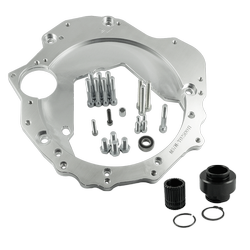
🔩 Engine - gearbox - transfer case adapters: precyzyjnie machined adapters for ZF, Getrag, or Nissan gearboxes. They guarantee accurate shaft positioning and compatibility with sports and stock clutches. Also available in versions for 8HP gearboxes.
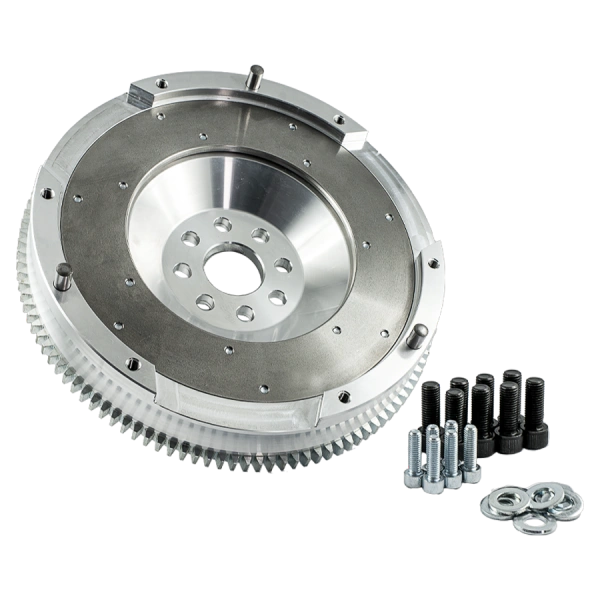
🪶 Lightweight flywheels: made of aluminum or chromium-molybdenum steel, they provide rotating mass reduction. Designed for 240 mm discs and twin-disc setups. They optimize engine response to the throttle and improve performance across the entire RPM range.
🧰 Clutch kits: ready configurations for 400 – 700 Nm torques, including organic, ceramic, and sinter twin-disc discs. Compatible with PMC single-mass flywheels and Sachs Performance or Tilton pressure plates.
⚙️ Short-shifters and shifters dedicated to 8hp: solutions for BMW E30 - E46, as well as for individual orders. They reduce lever travel and improve the rigidity of the drivetrain mounting.
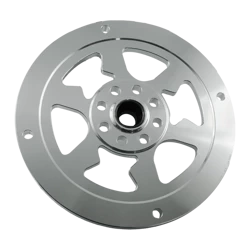
🔧 Components for 8HP gearboxes: adapters, flexplates, bolt sets, transfer case adapters allowing the installation of 8HP50/70/75 to M57. Supported by popular controllers like TurboLamik, CanTCU, xHP.
📦 Plug & play swap kits: complete packages containing all necessary elements for assembly: adapter, flywheel, bolts, bearings, installation manual. They save time and simplify the process.
Summary – everything worth knowing about M57
M57 and M57N engines are now classics in the world of tuning and swaps. Thanks to a durable design, high power potential, and easy availability, they are chosen both for light BMWs and heavy off-roaders. Each version has its strengths – from the simplicity of older models to the advanced technology of the M57N2.
If you are looking for a diesel engine that combines mechanical durability, flexibility, and the possibility of exceeding 300 HP without opening the block – you have just found it. And if you are planning a project based on the M57, check out the PMC Motorsport offer and reach for components created with your idea in mind.
Table: comparison of M57 versions
Parameter | M57 (1st gen.) | M57N / M57TÜ | M57N2 / M57TÜ2 |
|
Block | Cast iron (high rigidity, high mass) | Cast iron (reinforced, improved details) | Aluminum with sleeves |
|
Injectors | Solenoid CRI1, e.g., Bosch "047" | Solenoid CRI2, e.g., Bosch "131", "216" | Piezoelectric CRI3 |
|
High-pressure pump | Bosch CP1 | Bosch CP3 – mainly R70, in stronger versions R90 | Bosch CP3 – R70 or R90 (in 535d and the strongest usually R90) |
|
Turbochargers | Single VNT: mainly GT2556V / related (depending on model) | Single VNT: GT2260V / newer, higher efficiency | Single VNT (231–245 HP) or biturbo (272–286 HP), often GTB/sequential systems |
|
Controller / ECU | DDE4 / DDE5 (EDC15) | DDE6 (EDC16C1/EDC16CP) | DDE6.2 / DDE6.3 (EDC16CP35 and related) |
|
Typical stock power | 2.5–3.0d: approx. 163–193 HP | 2.5–3.0d: approx. 177–218 HP | 3.0d: 231–245 HP (single), 272–286 HP (biturbo) |
|
Typical tuning range – Stage 1 | ~230–250 HP, ~450–500 Nm | ~260–290 HP, ~520–600 Nm | single: ~280–320 HP | Biturbo: ~330 –360 HP, up to approx. 650–700 Nm |
Typical tuning range – Stage 2 | ~260–280 HP (IC, exhaust, intake), up to approx. 550 Nm | ~300–320 HP (IC, exhaust, better intake), up to approx. 650 Nm | single: ~320–350 HP | Biturbo: ~360 –380 HP, ~700 –750 Nm |
Typical tuning range – hybrid/"hard" | 300+ HP (hybrid turbo, stronger pump, fuel) | ~330–360 HP (GTB2260VK and similar, CP3 R90, strong clutch) | ~380 – 420+ HP (strong turbo/biturbo, CP3 R90, twin-disc clutch, EGT control) |
|
![Rigid Single-Mass Flywheel BMW E60 E61 525D 530D X3 3.0D X5 3.0D - 240mm / 9.45" [SMF]](hpeciai/e5609e3ecbb2cb9a24c05a9079a670bf/pol_il_Sztywne-kolo-zamachowe-BMW-E60-E61-525D-530D-X3-3-0D-X5-3-0D-240mm-9-45-SMF-5705.webp)