
Add products by adding codes
Engine Swap: Everything You Need to Know Before You Begin
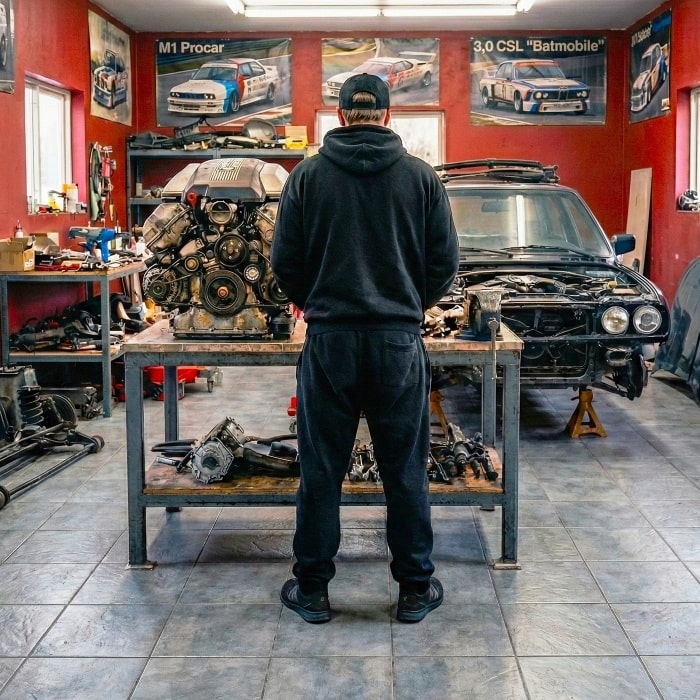
For many automotive enthusiasts, an engine swap is the ultimate form of vehicle modification – a process that allows for a fundamental transformation of its character, performance, and even reliability. It is much more than simple tuning; it is a heart transplant that gives the machine a completely new soul. Although this undertaking is complex, full of technical challenges and potential pitfalls, the satisfaction of owning something unique is the best reward. Step by step, based on documented experiences from successful projects, we will guide you through the entire process – from analyzing motivations, through planning and execution, to formal issues. All this to help you make an informed decision and realize the dream of a unique car built according to your own vision.
1. Why do an engine swap?
The decision to replace an engine is rarely dictated by a single, simple factor. On the contrary, it is almost always a strategic investment in the vehicle, resulting from an in-depth analysis of factory limitations and precisely defined design goals. Understanding these fundamental motivations is the key first step that determines the choice of the power unit, the budget, and the scope of the entire project.
Increasing Power and Performance: This is the most common and obvious motivation. When the factory engine reaches the limits of its tuning capabilities or their further development becomes unprofitable, a swap to a larger and more powerful unit becomes a natural step. Projects such as installing V8 engines in BMWs or crazy LS engine swaps into the MX-5 show that anything is possible. The popularity of swaps to legendary units, such as the Toyota 2JZ or Honda K24, results from their enormous potential to generate power while maintaining reliability. Not to mention such titans of longevity and potential as Lexus UZ units.
Improving Reliability: Sometimes a swap is not dictated by the desire to break records, but by the need to have a reliable vehicle. Replacing a failure-prone or worn-out factory unit with a more modern and durable design is a reasonable long-term solution. The best example is the BMW M57 engine swap into Nissan Patrols, thanks to which these cars gained a true second life. On the other hand, we have owners of Mazda RX series who replace their rotary engines with units of every displacement, from the Fiat 1.4T, Nissan 2.0T, through Honda 2.4, to the mighty 6.3 from GM.
Changing Vehicle Characteristics: A new engine can completely transform the driving experience, giving the car a completely new character. For example, a UZ series V8 swap into a Lexus IS200 turns a sporty sedan into a real monster.
Access to Better Transmissions: An engine swap is often inextricably linked with changing the transmission or even dictated by the desire to modernize it. Factory gearboxes may not be able to handle the power of the new engine. Therefore, high-performance projects often include the installation of much more modern transmissions. The undisputed king here is the ZF 8HP, which allows for achieving much higher performance from practically any engine.
Need for a manual gearbox: Some engines appeared with manual transmissions extremely rarely. Hence the huge popularity of GS6-53DZ gearboxes, which are mated with powerful V8s, such as the M62 or UZ, just as often as with Honda, Nissan, or Mercedes units.
Understanding your own priorities is absolutely crucial for the success of the project. Once you know what you want to achieve, you can start analyzing popular and proven options available on the market.
2. Most popular engines for swaps on the market
The world of swaps is extremely diverse, but a few engine platforms have dominated the market thanks to their versatility, reliability, power development potential, and enormous support from aftermarket parts manufacturers. It is these engines, thanks to thousands of successful projects, that have become a reference point for enthusiasts around the world. The following section presents the most recognized and proven options that form the foundation of the modern tuning scene.
GM LS Family
Engines from the LS family are often referred to as the "modern gold standard" in the world of swaps. Their push-rod V8 design is simple but extremely effective, and thanks to the use of aluminum (in some versions) they are surprisingly light and compact. They are characterized by an excellent power-to-weight ratio and enormous availability of both the units themselves and spare/tuning parts.
Popular Variants: The most frequently chosen are budget Small Block units coming from pickup trucks and SUVs. Even these units possess high power and enormous reserves of torque. Added to this are their sports variants, known from Corvette and Camaro models.
Typical Applications: Thanks to their compact dimensions, LS engines find their way into a wide range of vehicles – from small roadsters like the Mazda MX-5, through Japanese classics like the Nissan 240SX, to European models BMW E36/E46, and also classic American muscle cars.
Toyota JZ Family
The 1JZ and 2JZ engines are the undisputed "kings of the Japanese JDM scene". These inline six-cylinder units are famous for their legendary durability, mainly due to the armored, cast-iron block. As graphically stated in one comparison, "a professionally built 2JZ block can handle twice as much boost" as an aluminum LS block.
Popular Variants: The most desirable are the turbocharged 1JZ-GTE and 2JZ-GTE versions.
Typical Applications: JZ engines are a popular choice in drift cars, such as the Nissan 240SX and 350Z. They are also installed in various Lexus models (e.g., IS) and older Toyotas, like the classic Toyota Supra (A60/A61 generations). Very often they also find their way into BMW, Nissan, and even Mercedes cars.
Honda K Family
Engines from the K series are an excellent choice for enthusiasts looking for high revs, great efficiency, and Japanese reliability in a compact, four-cylinder package. They have been mass-produced for years, which makes them relatively inexpensive and easily available on the secondary market.
Popular Variants: The most popular models are K20 (2.0L) and K24 (2.4L).
Typical Applications: Due to their low weight and compact dimensions, these engines fit perfectly into lightweight cars, such as the Mazda MX-5, older generations of the Honda Civic, and even classic projects. These engines withstand powers more than twice as high as stock without forging, which makes them unrivaled in the price/potential category.
Nissan SR, VQ, and RB Engines
Nissan engines are a true motorsport legend. They are used in drift machines due to the very favorable torque curve in relation to power, a large base of tuning parts, and an enormous knowledge base.
Popular Variants: The most popular models are SR20 (2.0L) and RB (2.6L).
Typical Applications: Engines that are almost synonymous with drifting. Thanks to high power, which almost equals torque, they give great feel and ensure excellent performance. Units easy to tune with very good support facilities.
BMW Engines
BMW is known especially for its inline-6 (R6) units, which are used just as willingly in motorsport as in daily projects.
Popular Variants: The most popular models are the M54-58 family and the legendary M57 diesel engines.
Typical Applications: Every now and then, BMW creates units that gain cult status. From models M50-54, through N54-55, diesel M/N57, to V8 M60/62 – their engines are characterized by versatility and durability, which allows for application in practically every role.
It is also worth mentioning other noteworthy engines that have gained recognition on the tuning scene, such as the Australian, turbocharged Ford Barra (R6), whiteblock R5 engines from Volvo, or the immortal 1.8T from VAG.
3. Preparation for a Swap: Step-by-Step Guide
Choosing the right engine is, however, just the beginning of the journey. The next, much more demanding stage, is meticulous project preparation.Experience shows that the success of a swap project depends 90% on careful planning and preparation. It can be assumed that every hour spent on research and organization saves ten hours of frustration and unforeseen expenses in the garage. This strategic review of project management principles applied to automotive modifications breaks down the preparatory process into three key phases.
Phase 1: Research and Planning the Swap
This is the most important stage, which determines the success of the entire undertaking.
Defining Goals and Budget: Precisely define what you want to achieve: maximum power, daily reliability, or perhaps a unique character. Equally important is setting a realistic budget. The cost of a swap can range from 1,000 to over 50,000 dollars, but a safe practice is to multiply initial estimates to account for unforeseen expenses that will almost certainly arise.
Choosing Engine and Transmission: Select a power unit and gearbox that suit your goals and budget. Pay special attention to engine codes – subtle differences between variants, e.g., changes introduced in the middle of a production year, can be crucial for compatibility. Often one letter in the transmission code makes a difference that turns a plug&play project into a laborious search for custom solutions.
Compatibility Analysis: Fitment is much more than physical dimensions. You must verify the compatibility of key systems: engine and gearbox mounts, cooling system (hose placement, radiator efficiency), fuel system (pump capacity), exhaust system (available space for headers), and, most importantly, the electrical and electronic system.
Researching Similar Projects: Online forums, Facebook groups, and video services like YouTube are a goldmine of knowledge. Find and analyze documentation of swaps similar to yours. Learning from the mistakes and successes of others is the cheapest and most effective method of avoiding problems. You will often find people who have already gone through the entire swap process and are willing to share their knowledge.
Measure, measure, measure: Even the best engine is useless if it... doesn't fit. Before starting the swap, carefully measure the engine with the manifold and accessories and make sure everything will physically fit under the hood. The battery can always be moved to the trunk. The alternator – cannot.
Phase 2: Swap Checklist
After planning is complete, it's time for shopping.
Engine Sourcing: You have two main options. Buying a used engine is much cheaper but carries a risk regarding its technical condition. A new "crate engine" means certainty and warranty, but at a much higher price.
Key Supporting Components: The engine is just the beginning of the shopping list. To carry out the swap, you will need many additional parts:
Drivetrain:
Transmission
Clutch (often reinforced, e.g., twin-disc) and flywheel or possible flexplate
Driveshaft
Axles
Mounts:
Engine and transmission mounts/bushings (ready-made kits are available for popular swaps or custom elements will need to be made).
Electrical System:
Engine harness (you can modify the factory one, buy a new dedicated one, or use a fully autonomous system).
ECU (e.g., standalone like Ecumaster)
Transmission controller TCU for automatics (e.g., Turbolamik)
Fuel System:
Higher capacity fuel pump, new lines, external fuel pressure regulator.
Cooling System:
Radiator (often larger or with a different layout of ports), fans, matched hoses.
Exhaust System:
Exhaust manifolds/headers (one of the biggest fitment problems in tight engine bays), rest of the exhaust system.
Oil Pan:
In the case of some swaps, replacement or modification is necessary – a common case is the Volvo T5 Whiteblock.
Phase 3: Preparing the Workspace and Tools
Proper preparation of the garage is the basis for safe and efficient work.
Organization: Keep order throughout the project. Use labeled ziplock bags and boxes for all bolts, nuts, and small parts. This is a simple activity that will prevent hours of searching and frustration.
Essential Tools: In addition to a standard set of wrenches, you will need several specialized tools: a solid car jack and jack stands, an engine hoist, an engine stand, a torque wrench, a tool set, an impact wrench, a reciprocating saw - for more advanced work – tools for flaring brake and fuel lines, and a welder for creating custom mounts and exhaust systems. It is also good to stock up on a torch or heater to fight stuck bolts.
Solid preparation in these three phases minimizes the risk of failure and allows you to smoothly move on to the next stage – facing the challenges that will inevitably appear during the work.
4. Biggest Challenges and Problems during a swap
Even the best-planned swap will inevitably encounter problems. In the world of car modifications, Murphy's Law applies: "Anything that can go wrong will go wrong". The key to success is not avoiding problems, because that is impossible, but being aware of the most common pitfalls and being ready to solve them systematically. Knowledge of these challenges allows for faster diagnosis and more effective action.
4.1. Physical Fitment Problems
This is a category of problems where theory brutally collides with reality. Something that fits perfectly on diagrams may require invasive modifications in practice.
Description: "On paper" everything may look perfect, but millimeters make a difference. Reality in the engine bay often verifies even the most precise plans.
Examples:
Need to modify the firewall or transmission tunnel: Often the only way to find extra space is to use a hammer to gently "persuade" the sheet metal to make room.
Problems with exhaust header clearance: This is one of the most common problems. In extreme cases, installing headers requires removing the entire engine from the bay again.
Conflict with accessories: A new, wider engine may collide with elements such as the ABS pump, brake booster, or power steering system, forcing their relocation or replacement.
Engine block modifications: Physically cutting off a piece of the housing/block is often required to make room for the starter and accessory elements.
Lack of space for cooling: The factory radiator and fans often turn out to be too thick. This forces the use of thinner, more efficient replacements.
4.2. Electrical and Electronic Challenges
For many enthusiasts, this is the most terrifying and difficult aspect of a swap to master independently.
Description: Modern cars are complicated networks of interconnected modules. Integrating a new "heart" with the existing "nervous system" of the vehicle is a job for a good electromechanics specialist.
Examples:
"Plug and play" harnesses that don't work: Even dedicated, ready-made wiring harnesses can cause problems, turning out not to be fully compatible with a given year or trim level.
Startup problems: Prosaic faults, such as a broken wire in the harness or a wrong connection, can lead to hours of diagnostics and prevent the engine from starting.
ECU Integration: The new engine control unit (ECU) must communicate with the rest of the vehicle's electronics, including the CAN bus, immobilizer, comfort module, or ABS system.
Need to activate modules: Every module in the car must see its set of sensors. Otherwise, there will be a problem with the operation of even basic gauges and functions.
4.3. Unexpected Complications and Costs
Budget and schedule are one thing, and workshop reality is another. You should always be prepared for the unexpected.
Examples:
Used engine: Buying a used engine is sometimes a lottery. Be sure to verify the condition as best as you can.
Need to buy additional parts: During assembly, it often turns out that previously unforeseen components are needed, such as a different throttle body, a shorter accessory belt, or specific adapters.
Breaking bolts and breaking tools: Working on older cars is a constant battle with seized and rusted bolts that can snap at the least appropriate moment.
"While I'm at it" effect: Engine removal is the perfect opportunity to replace other worn parts "while at it", such as seals, water pump, or suspension elements. This significantly raises costs and extends the project time.
4.4. Post-Startup Issues
The first successful engine start is not the end of work, but only the beginning of the testing and teething trouble removal phase.
Description: The new configuration requires precise tuning and testing in road conditions. The first kilometers are a time of intensive diagnostics.
Examples:
Overheating: Often caused by air in the cooling system, which requires patient and correct bleeding.
Leaks: Coolant, engine oil, power steering fluid – after the first start, all connections must be thoroughly checked.
Vibrations and Noises: May result from poorly fitted mounts, contact of exhaust system elements with the chassis, or an unbalanced driveshaft.
Transmission problems: Difficulties shifting gears or clutch problems often require readjustment or bleeding of the hydraulic system.
Uneven running: An engine after a swap often needs tuning to start working correctly on new software.
Patience, a systematic approach, and readiness to learn are key to overcoming these challenges and bringing the project to a happy conclusion.
5. Transmission Adapters
The heart of many modern swaps are precisely made adapters and flywheels, which act as "translators" between components coming from different manufacturers. They allow popular engines to be combined with durable and easily accessible transmissions, opening the door to almost unlimited drivetrain configuration possibilities.
Donor Engine | BMW Manual Transmissions (ZF GS5/GS6) | ZF 8HP Automatics | DCT/DKG Transmissions | Nissan Transmissions (CD009/350Z) |
Audi V8 4.2 ABZ | YES | NO | NO | NO |
BMW M50 / M52 / M54 / S50 / S52 / S54 | YES | YES | YES | NO |
BMW M57 / M57N / M57N2 | YES | YES | NO | NO |
Chevrolet LS / LT / Vortec (GM) | YES | YES | YES | YES |
Ford Barra | YES | YES | YES | YES |
Honda K20 / K24 | YES | YES | YES | YES |
Mitsubishi 4G63 | YES | YES | NO | NO |
Mercedes-Benz OM605 / OM606 | YES | YES | NO | NO |
Nissan RB (RB20, RB25, RB26, RB30) | YES | YES | YES | YES |
Nissan SR (SR20DET, SR20DE) | YES | YES | YES | YES |
Toyota JZ (1JZ, 2JZ) | YES | YES | YES | YES |
Toyota UZ (1UZ, 3UZ) | YES | YES | YES | YES |
6. Icons of the Tuning Scene: best engines for swaps
Although there are hundreds of different engines available on the market, only a few models have gained legendary status, becoming icons of the tuning scene. Their popularity is no coincidence – it is the result of a unique combination of performance, modification potential, reliability, and enormous community support. In this section, we will conduct a detailed analysis of their characteristics to help you choose the ideal power unit.
GM LS V8: Versatile Muscle from the USA
Characteristics: The LS engine is a simple but extremely effective V8 design with a single camshaft in the block (push-rod). This architecture makes it surprisingly compact and light, especially in versions with an aluminum block, which facilitates its installation in tight engine bays.
Pros:
Versatility and Availability: These engines can be found almost everywhere, from millions of trucks and SUVs to sports Corvette models, which makes them easily available and relatively cheap.
Cost: Salvaged versions, especially from commercial vehicles, are one of the cheapest ways to obtain high power. Spare parts are available and relatively cheap.
Power "out of the box": Many stock versions offer impressive 300-400 HP without any modifications, which provides an excellent base for further tuning.
Support: A huge community worldwide and a gigantic aftermarket parts market mean that practically every problem has already been solved, and an answer can be found for every question.
Cons:
Weaker bottom end: Compared to the armored 2JZ block, stock LS engine components (especially connecting rods and pistons) are not as resistant to extreme boost and require reinforcement at very high power levels.
Characteristics: It is a classic V8 – it offers powerful torque from low revs, but it lacks the high-revving, aggressive character typical of many Japanese engines.
For whom: Choosing an LS engine is a strategic decision for maximum versatility and parts availability, ideal for projects where aftermarket support and cost predictability are key.
Toyota JZ (1JZ/2JZ): The Japanese Titan
Characteristics: The JZ engine is an inline, six-cylinder unit (I6) with an incredibly solid, cast-iron block. It was designed with a huge margin of durability, which made it a legend in the tuning world. In recent years, its availability has dropped significantly, but relatively cheap Lexus cars, in which it was also installed, can still be purchased.
Pros:
Durability: The JZ engine block is often referred to as a "tank". In the stock turbo version, it is able to accept enormous boost and generate extreme power on stock internal components, which is a rarity.
Reliability: These engines are the embodiment of Toyota's reputation. With proper servicing, they easily achieve mileages exceeding 300,000 miles while maintaining their performance.
Non-interference timing: An important design feature that protects the engine from destruction in the event of a timing belt break. Pistons and valves will not meet in such a situation.
Cons:
Availability and Cost: Their legendary status has caused prices to skyrocket. Most turbo engines come from imports from Japan (JDM), and finding a unit in good condition is becoming increasingly difficult and expensive. Parts may require longer waiting times.
Weight and Size: The cast-iron block and inline design make it a long and heavy unit compared to more compact V8 engines, which can negatively affect vehicle weight distribution.
For whom: The decision to choose a JZ engine is an investment in legendary durability and potential for extreme power, best for projects where the priority is the ability to withstand huge boost at the expense of higher price and lower availability.
BMW M57 Engine Family – The German Tank
These diesels have become very popular in projects where high torque is key. M57 units are often chosen for engine swaps in off-road vehicles, such as the Nissan Patrol, combining modern German diesel technology with off-roader durability. They are valued for reliability, high potential, and are often adapted to ZF 8HP automatic transmissions. Power in the range of 300 horsepower is no challenge for them, while maintaining high work culture, reasonable fuel consumption, and failure-free operation.
Pros:
Durability: The M57 are some of the most durable engines ever created. With proper service, they can travel a million kilometers without an overhaul. They withstand much higher power than factory without losing much of their legendary armored nature.
Reliability: The first series were devoid of complicated accessories and are considered the most reliable. But they also have the least potential. Compared to modern units, even the M57N2 variant, considered less reliable, is a unit that can be relied upon.
Access to parts: The crazy popularity of the M57 translates into great access to relatively cheap parts. Many replacements can be found on the market, including sports ones with increased durability.
Cons:
Availability and Cost: Their legend is slowly starting to drive prices up, especially the oldest M57s on the cast-iron block. However, millions of cars equipped with the M57 are still driving around the world, so the pool of engines remains large with each passing year.
Weight and Size: The engine is quite large and heavy, especially the first series. That is why it is often used in off-road cars, where this is not a big problem. Cases of building track or drift projects with the M57 also happen, but they are much rarer, partly due to the weight and size of the engine.
For whom: For people who are looking primarily for huge torque available from the very bottom. And for people for whom durability and resistance is a priority. In off-road, the engine has cult status and has already appeared in most professionally prepared Nissan Patrols.
7. Summary: Is an Engine Swap for You?
An engine swap is one of the most ambitious and satisfying undertakings in the automotive world, but it is certainly not a path for everyone. It is a test of skills, patience, and determination. It requires passion, readiness to learn, and above all – careful, thoughtful preparation. However, for those who are ready to take on this challenge – the reward is worth it. With the right knowledge and the right approach, the dream of building a unique "Frankenstein" in your own garage can become an extraordinary adventure.