
Add products by adding codes
Everything about Toyota 1JZ and 2JZ engines – design, modifications, disadvantages

The 90s in Japan were the time of the so-called "Bubble Economy" – a period when accountants had no say, and engineers had an almost unlimited budget. It was in these conditions that the JZ series was born. Toyota needed a modern successor to the aging M series (which struggled with head gasket problems in the 7M-GTE model) and had to challenge the growing competition, especially Nissan and its RB26DETT engine. The goal was to create a unit that was not only powerful but also silky smooth and... mechanically indestructible. The result of this engineering "arms race" exceeded the creators' wildest expectations, giving us a block that withstands power outputs three times higher than stock.Today, more than 30 years after its premiere, these engines still power tens of thousands of cars destined for racing in practically every field of motorsport except rallying. So let's look at the solutions that made the JZ the benchmark for what an engine should be.
1. Construction and Architecture: Foundation of "Undestructable" legend
JZ engines (1JZ and 2JZ) are inline-sixes (R6/I6) that replaced the older M series. Their potential stems from several key design decisions:
Cast Iron Block: The foundation of legendary durability is the block cast from cast iron. Although it is a much heavier material than aluminum, cast iron provides exceptional rigidity and resistance to extreme cylinder pressure, which is crucial for forced induction. Cast iron handles heat dissipation well and possesses micro-vibration damping properties, which perfectly compensates for the increased mass.
"Closed-Deck" Construction: The block features a closed upper surface. The water jacket does not surround the cylinders from the top, which maximally reinforces their walls and prevents ovalization under load. Such a design is much more complicated to engineer than an open deck, but at the same time provides unmatched durability.
Crankshaft: In the GTE version, it is made of forged steel and supported by seven massive main caps, which promotes stability even at very high RPMs. Such a crankshaft withstands immense boost, which is why users most often replace this part last.
Head: Developed in cooperation with Yamaha, an aluminum, 24-valve DOHC design. Very reliable and equipped with large alloy steel valves (intake) and heat-resistant steel (exhaust). For the needs of a stock engine, they are indestructible, but for projects, replacement with aftermarket valves made of stainless steel (intake) and Inconel (exhaust) is necessary
- Pistons: In the 1JZ version, the pistons are forged; in the 2JZ, cast hypereutectic pistons were used. This means a casting with a high silicon content. They are very hard and wear-resistant, but at the same time more brittle than forged aluminum. Toyota used a very thick casting and an excellent cooling system (oil squirters on the crowns)
Geometry: Square vs Oversquare
Here lies the key difference in the characteristics of both brothers:
2JZ-GTE (3.0L): A "Square" engine. Bore and stroke are identical: 86.0 mm x 86.0 mm. This 1:1 ratio ensures an ideal balance between torque at low RPM ("low end") and maximum power.
1JZ-GTE (2.5L): An "Oversquare" engine. With the same 86.0 mm bore, the stroke is only 71.5 mm.
Effect: A more favorable rod-to-stroke ratio (Rod Ratio ~1.75 vs ~1.65 in 2JZ) makes the 1JZ generate less side force on the piston and much more willingly revs to high RPMs, generating a characteristic, high-pitched sound.
2. Version Overview: The JZ Family Complete
JZ is not just powerful, turbocharged 3-liters, but also an entire family of engines that served to power mid-sized and large sedans - including those we would consider the Japanese equivalent of the Passat.
A. 1JZ-GE (2.5L Naturally Aspirated)
Often overlooked, though worth attention as a base for building a powerful project.
Characteristics: No turbo, power approx. 180 HP (non-VVTi) to 200 HP (VVTi).
Construction: Compression ratio 10.0:1. No oil squirters on piston crowns.
Application: Great engine for a daily driver. It's cheap, sounds like a thoroughbred JZ, but consumes less fuel and is simpler.
Potential: Can be turbocharged, just like the 2JZ GE
B. 1JZ-GTE (2.5L Turbo) – "Japanese Symphony"
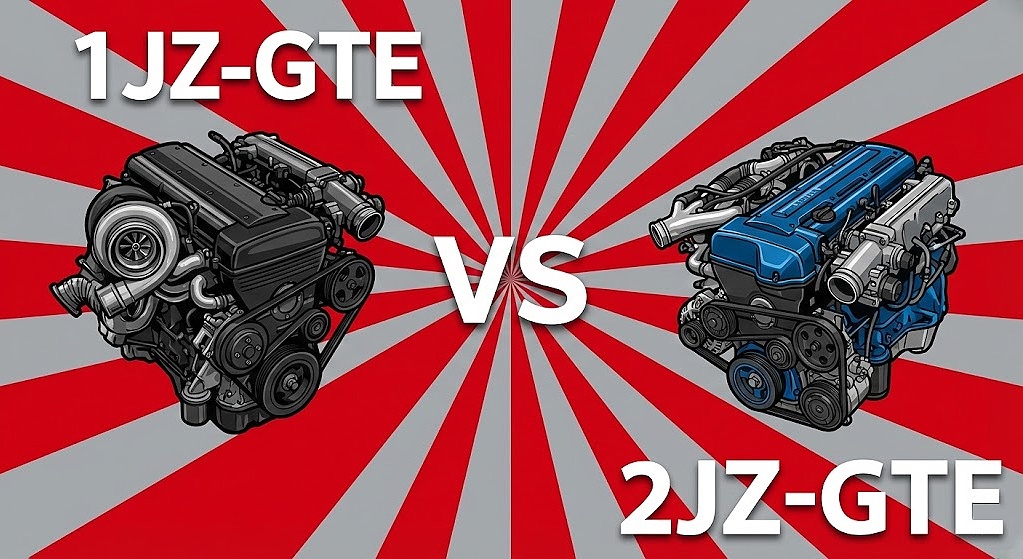
Drifters' favorite. Forged pistons (stock), great throttle response, and a sound resembling a motorcycle. Available as Twin Turbo (CT12A) or Single Turbo (VVTi, CT15B).
C. 2JZ-GE (3.0L Naturally Aspirated) – "Best turbo base"
Most popular in Europe (from Lexus GS/IS). Has a high compression ratio (10.5:1), which after adding a turbo gives brilliant throttle response but requires careful tuning.
D. 2JZ-GTE (3.0L Twin Turbo) – "The King"
Flagship unit. Sequential turbo, powerful torque, oil squirters on pistons. This engine built the entire legend and cult of the 2JZ.
3. Version Differences: 1JZ vs 2JZ, GE vs GTE
Feature | 1JZ-GTE (2.5L Turbo) | 1JZ-GE (N/A) | 2JZ-GTE (3.0L Twin Turbo) | 2JZ-GE (3.0L N/A) |
Capacity | 2491 cc |
2491 cc
| 2997 cc | 2997 cc |
Power (Nominal) | 280 HP | 180-200 HP | 320 HP (USDM) / 280 HP (JDM) | 212–230 HP |
Compression Ratio | 8.5:1 / 9.0:1 (VVTi) | 10.0:1 | 8.5:1 | 10.0:1 / 10.5:1 (VVTi) |
Pistons | Forged (depending on year) | Cast | Cast, dished (low CR), hypereutectic | Cast, flat (high CR) |
Oil Squirters | YES (Oil Squirters) | NO | YES (Oil Squirters) | NO (usually) |
Connecting Rods | Armored | Standard | Armored | Standard / Thin (in VVTi version) |
Turbo | Twin Parallel (CT12A) or Single (CT15B in VVTi) | None | Twin Sequential (CT20 - JDM / CT12B - Export) | None |
4. Where to get a JZ engine? List of models and donors
Most JZs on the market come from imports (JDM) or dismantled Lexus cars. Remember that the oil pan (Sump) differs depending on the model (Front/Mid/Rear Sump), which matters for a swap.
Where to find 1JZ-GTE / GE?
This is the domain of Japanese sedans and coupes that rarely made it to Europe.
- 1JZ-GE: Toyota Mark II/Chaser/Cresta (JZX90/100), Toyota Crown (JZS151/171), older Lexus models (less common).
Toyota Soarer (JZZ30): Very popular donor. Early models had Twin Turbo (non-vvti), later ones (from 1996) Single Turbo VVTi.
Toyota Chaser / Mark II / Cresta (JZX Series): The Holy Grail of drifters.
JZX90: 1JZ Twin Turbo (non-vvti).
JZX100: 1JZ Single Turbo (VVTi) - most sought after variant.
JZX110 / Toyota Verossa: Last releases of 1JZ VVTi.
Toyota Crown (JZS171): Often a cheaper alternative to the Chaser, same engine (1JZ VVTi).
Toyota Supra Mk3 (JZA70): Only late JDM versions (2.5 Twin Turbo R).
Where to find 2JZ-GTE?
Toyota Aristo (JZS147 / JZS161): Definitely the cheapest source of 2JZ-GTE. JZS147 has the non-vvti version, JZS161 has the VVTi version with immense torque.
Note: Aristo has an automatic transmission and a Front Sump oil pan.
Toyota Supra Mk4 (JZA80): The obvious choice, but due to car prices, no one buys a Supra to pull the engine out of it.
Where to find 2JZ-GE?
Easiest to find in Europe and USA.
Lexus GS 300 (Gen I and II): Very popular in Europe. Engine is cheap, bulletproof with some mods, but naturally aspirated.
Lexus IS 300 (Gen I): Great, compact car with 2JZ-GE VVTi. Remember the thin connecting rods in this version!
Lexus SC 300: American equivalent of the Soarer, but with N/A 3.0.
Toyota Supra Mk4 (N/A Versions): Rare in Europe, more popular in UK.
5. Tuning Potential and Modifications
The potential of the JZ is legendary, but it must be considered in the context of durability. Projects reaching 2000 horsepower built the JZ legend, but in practice, most owners are satisfied with 450-600 horsepower.
A. Stock Bottom End
2JZ-GTE: Safe 600-700 HP. At 800 HP we are on the edge of risk.
1JZ-GTE: Similar potential (600-700 HP), with the engine handling high RPMs better.
2JZ-GE (NA-T): On "thick rods" (non-VVTi) approx. 450–500 HP. Above this limit, high compression pistons become a problem. It is necessary to replace the stock connecting rods, which can bend even at 0.8 bar boost.
- 1JZ-GE: Has slightly more potential than the 2JZ GE, around 500-600 HP. Although newer 1JZ-GE VVTi also have thinner connecting rods, thanks to the shorter crank throw (shorter stroke), the forces acting on the rod are lower, and the torque builds up more gently. The ratio of rod length to piston stroke in the 1JZ makes this engine generate less side force on the piston (less cylinder ovalization). Early versions of the 1JZ-GE (non-VVTi) got heads with very large intake ports.
B. Build for 800 - 1000 HP+ (Forged Engine)
Pistons: Alloy 4032 (quieter, for street) or 2618 (more durable, loud when cold, for racing).
Ring End Gap: Gaps need to be increased (e.g., to 0.017") to avoid seizing under the influence of temperature.
Head Studs: Standard ARP up to 800 HP. Above that, ARP Custom Age 625+ alloy is recommended.
Main Caps: Above 900 HP stock caps can "float" (cap walk). Billet caps + line honing required.
Cams: At this power, camshafts with more aggressive profiles will be needed.
Intercooler: A thick intercooler with a massive core is sufficient up to about 900 horsepower. Above this power, it is better to use a water-to-air intercooler.
Computer: The factory Toyota computer cannot be reflashed (reflashed). This requires installing a standalone ECU (Standalone ECU), such as Haltech Elite 2500, Link G4X Fury, AEM Infinity, or ECUMaster EMU Black
Injectors: Usually 1050cc to 2000cc, especially when using E85 fuels
Pumps: Dual or triple high-performance fuel pumps (e.g. Walbro 450 LPH)
Fuel Rail and Regulator: High-flow fuel rails (e.g. Radium) and a boost-referenced fuel pressure regulator (boost-referenced FPR)
Fuel: E85 fuel (ethanol) is highly recommended because it has a higher octane rating, which reduces the risk of knocking (detonation), the main killer of modified engines
6. Weak Points of JZ engines
Like every engine, the JZ also has a few weak points. Compared to other units, however, they are minor issues that can be dealt with easily and relatively cheaply.
Oil Pump Gears: No. 1 cause of failure. Factory sintered gears break under heavy abuse. Mandatory installation of Billet Gears.
Valve clearance is not hydraulically adjusted! JZ engines do not have hydraulic lifters. Clearances are adjusted manually with shims.
Crank pulley: Rubber rots, pulley falls apart. Replace with new OEM or ATI Super Damper.
Coils and ECU: Many components are over 25 years old. Old coils crack, and capacitors in the ECU leak. This is not a big problem as most projects use stronger coils and standalone ECUs.
- Connecting Rods in 2JZ GE: The biggest pain of cheap 2JZ-GE engines (from the VVTi era, i.e., Lexus IS300/GS300 MK2) are their connecting rods. They are much thinner than in the GTE version (referred to in the community as "matchsticks"). With boost around 0.8 bar and high torque generated by the 3.0L capacity, these rods can bend.
- Cooling System: Due to its construction, this engine does not tolerate any neglect in the cooling system.
7. FSE Versions 1JZ-FSE / 2JZ-FSE – A Trap in the World of JZ Engines
On the aftermarket, especially in imports from Japan (JDM), temptingly cheap engines marked 1JZ-FSE and 2JZ-FSE often appear. You can find them in models such as Toyota Brevis, Progres, or late model years of Crown and Mark II (from approx. 2000).
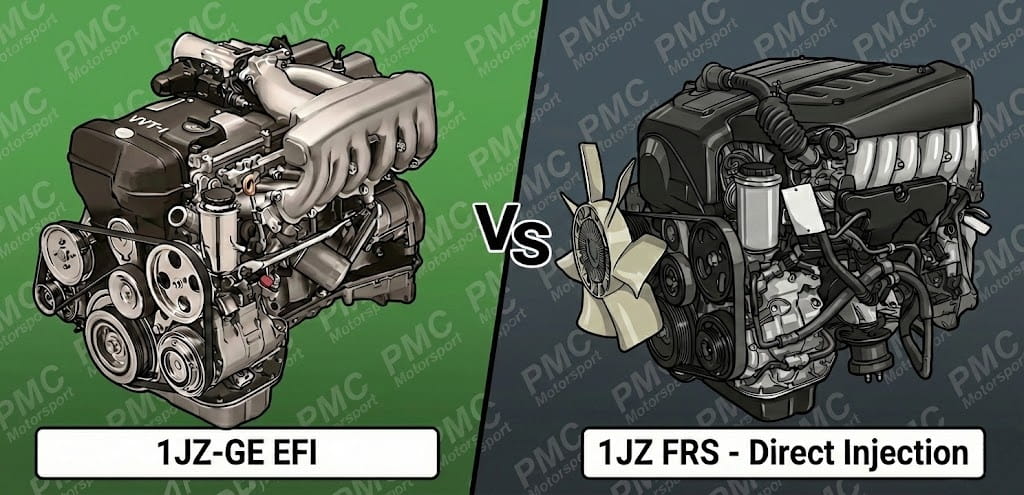
The abbreviation FSE stands for the use of Toyota D-4 direct fuel injection system (Direct Injection 4-Stroke Gasoline Engine). Although for the average user it is just a way of delivering fuel, from a tuner's perspective it is a completely different design and useless for motorsport.
Restrictive Head (High-Tumble Ports): This is the main reason for disqualification. Heads in FSE engines were designed for ecology and economy, not flow. Intake ports are very narrow and positioned almost vertically to force air turbulence in the cylinder (so-called tumble effect), which helps in burning lean mixtures.
This head becomes a bottleneck at higher RPMs. Physically, it is unable to pass the amount of air needed to generate high power, and intake manifolds from GE/GTE versions do not fit.
Pistons and Compression Ratio (CR): FSE engines operate at a very high compression ratio (11.3:1) to efficiently burn fuel injected directly.
Piston crowns have a specific, deep shape (bowl), designed to direct the fuel cloud towards the spark plug. Such a shape creates "hot spots", which lead to immediate, destructive detonation when attempting forced induction.
Fuel System and Electronics: The D-4 system requires a mechanical high-pressure pump (driven by the camshaft) and specific injectors located in the combustion chamber.
The stock fuel system does not have the capacity for high power, and aftermarket injectors or pumps for early Toyota DI systems practically do not exist. Moreover, tuning this engine requires an advanced Standalone ECU with direct injection support, which drastically increases costs compared to simple port injection in GE/GTE.
Weak Bottom End: Connecting rods in FSE versions are the thinnest in the entire JZ family. They were optimized for reducing rotating mass and friction resistance at low loads. They do not possess the durability reserve known from GTE versions or even older GEs.
Carbon Buildup: Because fuel is injected directly into the cylinder, it does not wash the intake valves (as in port injection). This causes intake valves in FSE engines to be coated with a thick layer of oily carbon deposit from the PCV over the years, which further chokes the already restrictive airflow.
8. Technical and Service Data for 1JZ 2JZ engines
General Parameters
Parameter | 1JZ-GE | 1JZ-GTE | 2JZ-GTE | 2JZ-GE |
Bore x Stroke | 86.0 x 71.5 mm | 86.0 x 71.5 mm | 86.0 x 86.0 mm | 86.0 x 86.0 mm |
Firing Order | 1-5-3-6-2-4 | 1-5-3-6-2-4 | 1-5-3-6-2-4 | 1-5-3-6-2-4 |
Compression Pressure (Nominal) | 12,5-13.5 bar | 11.0 - 12.0 bar | 10.8 bar (156 psi) | 12.5 - 13.0 bar |
Compression Pressure (Minimum) | 10.5 bar | 9.0 bar | 8.8 bar | 10.5 bar |
Oil Pressure (Idle) | Min. 0.8 bar | Min. 0.8 bar | Min. 0.8 bar | Min. 0.8 bar |
Oil Pressure (3000 rpm) | 3.3 - 5.9 bar | 3.2 - 5.8 bar | 3.3 - 5.9 bar | 3.3 - 5.9 bar |
Valve Clearances (Cold)
Note: Shim adjustment (Shim-over-bucket or Shim-under-bucket in performance heads).
Engine | Intake | Exhaust |
1JZ-GTE / 2JZ-GTE | 0.15 – 0.25 mm | 0.25 – 0.35 mm |
2JZ-GE | 0.15 – 0.25 mm | 0.25 – 0.35 mm |
9. Not just the engine: Which transmission to pair with a JZ?
A stock manual transmission from a Supra Twin Turbo (Getrag V160/V161) is nowadays an expense of at least 10 thousand euros. The legendary Toyota R154 is becoming increasingly rare and expensive. What to do? Polish engineering comes to the rescue. PMC Motorsport offers adapter kits and lightweight flywheels that allow you to mate the Japanese legend with gearboxes that you can find on any classifieds site and buy for reasonable money.
Here are the 6 best transmission proposals for your JZ:
BMW ZF 8HP (8HP70 / 8HP90): The absolute "Gamechanger" of recent years. A modern, 8-speed automatic fitted in BMWs, Jaguars, or Dodges, among others. Thanks to controllers (e.g., Turbo Lamik), the transmission shifts gears in the blink of an eye, is incredibly durable (version 8HP70 handles 1000 Nm+), and offers comfort for daily driving. This is currently #1 for Street/Drag projects.
BMW ZF GS6-53DZ (6-speed Manual): "The King of Cost-Effectiveness". A transmission originating from BMW 3.0d diesels (E60, E90). It is cheap to buy, easily accessible, and armored – withstands "clutch kicks" at power levels of 800-1000 Nm. PMC offers a complete kit with a twin-disc clutch for it.
BMW DCT / DKG (Getrag GS7D36SG): Dual-clutch transmission from BMW M3 (E90/F80) or M4. If you are building a track car (Time Attack) and need instant downshifts with rev-matching and paddle shifters, this is the choice for you. Requires advanced control, but gives a race car driving feel.
Nissan CD009 (6-speed Manual): Transmission from Nissan 350Z/370Z. Legendary construction "impossible to kill". It is heavy and operates with high resistance, but its durability is comparable to the stock Getrag V160 for a fraction of its price. Ideal if you want to keep the "Japanese character" of the drivetrain.
BMW ZF S5D-320Z (5-speed manual): Budget option (“Entry Level”). Transmission from BMW E36 328i and E34. Costs pennies. Not as strong as GS6-53DZ (unofficial limit approx. 700 Nm), but perfectly sufficient for lighter cars and “basic” 1JZ (approx. 350-400 hp).
GS5-39DZ (5-speed manual): A drifting legend. A gearbox found in the E39 530D, which can handle 900-1000 Nm in real terms.
Tip: When deciding on an adapter, remember that the key is not only the "adapter plate" but primarily the appropriate flywheel (Custom Flywheel). PMC Motorsport produces dedicated flywheels for the Toyota starter, which makes the whole thing fit plug-and-play, eliminating the need to weld bell housings.
10. Alternatives to JZ: What instead of the Legend?
The prices of 2JZ-GTE swaps are rising year on year. So what alternatives do we have?
BMW M50/M52/M54 (Turbo): "German 2JZ". Cheap and easily accessible engines fitted in many BMW models. M50 (cast iron) withstands 500 to 700 HP after forging, sounds great, and has a large spare parts market.
BMW B58 (3.0 Turbo): Spiritual successor to the JZ (known from the new Supra). Thanks to "closed deck" construction, refined design, and full use of modern technology potential, this engine reaches 500 HP+ with just soft tuning. This is definitely the future of tuning and a unit that is already starting to dominate motorsport. The best builds are already reaching powers over 1500 horses.
Nissan RB25/RB26: The eternal rival. Sounds wonderful, but is much more expensive to service and has a weaker oil system. It also has a smaller spare parts market.
LS (GM V8): Cheapest horsepower among large displacement engines. It was not an engine designed for motorsport, but trucks – it doesn't offer such dynamic revving, although it makes up for it with a powerful roar, a huge spare parts market, and armored construction.
Honda K24 + turbo: Budget option for 500 horses, however, its potential on stock components practically ends there. It revs very quickly, has a huge market of cheap and available units and a knowledge base. Unfortunately, it still sounds like a Honda, not like a monster with 6/8 cylinders.
2JZ – more than an engine
Choosing a 1JZ or 2JZ engine nowadays is something more than pure economic calculation. A BMW M50 will do it cheaper, an LS V8 simpler. But JZ is the aristocracy of tuning. It is an engine that ennobles every car. Its sound, parts availability, and 30 years of history make it still the king despite the passage of years. Considering the direction in which modern motoring is heading, this king will never step down from the throne.
Recommended
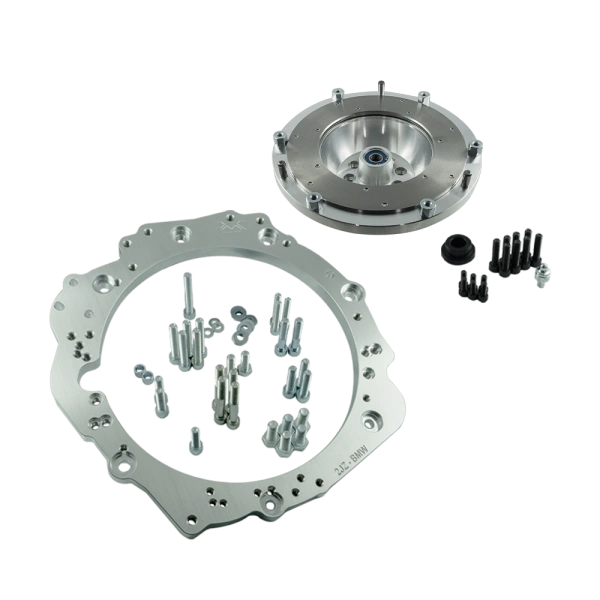
Adapter Toyota 1JZ 2JZ - 6-speed manual BMW M57n GS6-53DZ HGD JGA HGA - 240mm / 9.45"

Adapter Toyota JZ 1JZ 2JZ - Nissan 350Z Z33 CD009 / Nissan 370Z Z34 JK - 250mm / 9.84"
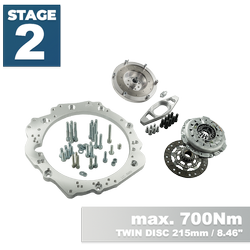
Stage 2 Toyota 1JZ 2JZ - 6-speed manual BMW N54 GS6-53BZ 135i 335i 535i 215mm / 8.46" Twin Disc
