There is no such thing as a perfect device, especially when we are talking about a technological masterpiece like the ZF 8HP transmission. Understanding the weak points of this gearbox requires moving away from its image as a totally failure-free component. Potential failures stem directly from the advanced architecture of the unit, characterized by extreme component packing density and a high degree of mechatronic system integration.
These features, while desirable in terms of performance, make the transmission susceptible to service errors and specific operating conditions. In the case of radical engine parameter modifications and swaps, knowledge of typical faults is essential for maintaining the mechanical integrity of the system.
018HP Mechatronics: What to Watch Out for During Service
The ZF 8HP mechatronics unit combines a precision hydraulic valve body with a TCU module and is extremely sensitive to oil cleanliness and the precision of assembly procedures. This is why a strict approach to oil changes is so important — for civilian applications, ideally every 60 000 km, and much more frequently for performance vehicles.
Some manufacturers, such as BMW, put a "lifetime oil" sticker on the transmission. Technically, this is true — the oil will last until the end of the transmission's life, which is about 150 000 km. If you want a long (over 300 000 km), trouble-free service life — you should ignore the manufacturer's recommendation and maintain regular changes with the specified oil.
Critical Position Sensor Error
One of the most serious faults during swaps, which prevents engine start-up, is the improper seating of the drive position sensor. During installation of the mechatronics module inside the housing, the use of dedicated guiding pins is strictly required. Their absence often leads to incorrect positioning of the sensor relative to the internal mechanism. The TCU interprets this as a critical error and triggers a start-block condition — in practice, this means the vehicle will not start the engine after service due to a logical gear selector position error.
Never install the mechatronics module without dedicated guiding pins. No pins = start-block error = car won't start after service.
EDS Regulator Contamination
The electromagnetic pressure regulators react to even the smallest contaminants in the oil. This results in the phenomenon known as "gear hunting" and harsh downshifts. System pressure instability, which is nominally 17 bar, directly affects the shift quality of the transmission. Technical documentation strictly prohibits any attempts to reconfigure EDS pressure regulators by unauthorized individuals. It is best to rely on the experience of tuners who generally know what modifications they can safely make in tuning projects.
6HP Legacy: Error 4E86 and Interlock Fault
Many tuners working on BMW platforms (especially the E60 model) encounter the error code 4E86 MV3 — Interlock fault. This is a classic example of a fault arising from the transition between 6HP and 8HP technology. It results from a mismatch between the software configuration and the hardware interlock logic.
Look for the problem in your CAN adapter configuration or in the TCU software (e.g., an incorrectly set 6-speed gearbox emulation mode). Error 4E86 (Solenoid Valve 3 / Interlock) is a native error code for the 6HP transmission. In the 8HP, error codes are typically 6- or 8-digit (e.g., 420641 — parking position sensor error).
028HP Transmission Cooling
The factory cooling systems in the ZF 8HP, despite their efficiency under normal road conditions, show limitations under increased torque loads or prolonged towing. This leads to overheating and the transmission entering limp mode.
The torque converter lock-up clutch is subject to intense degradation under high thermal loads. The main symptoms of dysfunction include:
- Shuddering — noticeable while driving at a constant speed, the effect of irregular slipping of the lock-up disc.
- Surface glazing — a permanent change in the friction material structure of the disc, leading to a loss of the friction coefficient.
- Oil contamination — aggressive driving accelerates disc wear, which saturates the ATF with fine particles that then clog valves in the mechatronics.
- Fluid degradation — worn-out oil loses its friction-modifying properties, which destabilizes the operation of the lock-up clutch.
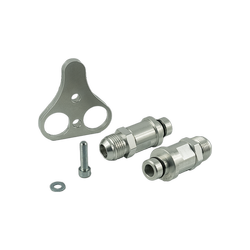
The solution to these problems in the tuning world is thermostatic adapters that eliminate factory bypass valves. They force 100 percent oil flow through an external cooler from the moment of engine start-up, effectively protecting seals and discs from thermal degradation.
038HP Diagnostic Checklist — Symptoms, Causes, Repairs
Most failures are progressive in nature and result from exceeding the system's operating limits. Below you will find a diagnosis of the basic problems that can occur in the ZF 8HP:
| Symptom | Potential Cause | Verification Method / Repair |
|---|---|---|
| Jerk / harsh shift 2→1 | Excessive play on the flex disc | Check flex disc for play and cracks |
| Delayed engagement P→D | Low line pressure / low ATF level | Run pump diagnostics; check oil condition at 35°C |
| Shuddering while driving | Worn lock-up clutch in the torque converter | Real-time analysis of converter slip parameters |
| Gear hunting | EDS regulator contamination or TCU calibration error | Dynamic oil change + adaptation; software update |
| No start after service | Incorrect mechatronics position sensor installation | Reinstall mechatronics using dedicated guiding pins |
| Error code 4E86 | Software configuration mismatch with interlock logic | TCU coding procedure; verify software compatibility |
| Limp Mode (thermal) | ATF temperature exceeded — missing or overloaded cooling system | HPR thermostatic adapter or Sure-Cool STL025; external cooler |
None of the above symptoms appear suddenly. Every problem starts with subtle signals — minor jerks, momentary delays, or minimal vibrations. Regular diagnostics and service are the only way to catch faults before they become catastrophic.
04ZF 8HP Service Bible: Intervals and Checklist
In ZF 8HP transmissions, fitting tolerances and EDS valve response times are measured in microns and milliseconds. The operating parameters of the transmission are inseparably linked to the chemical condition of the ATF fluid. Every kilometer driven under high dynamic highway conditions, performance driving, or towing accelerates the thermal degradation of the oil, leading to polymer oxidation and a loss of viscosity stability.
We recommend changing the oil every 60 000 – 80 000 km or a maximum of every 8 years. Under intensive operating conditions (frequent kick-down cycles, high ambient temperature operation), this interval must be unconditionally shortened — down to as little as 5 000 km for drift and rally use.
Checklist for Every ZF 8HP Service
- Leak inspection — special attention must be given to the mechatronics socket seal and the oil pan edges. The plastic pan can deform — in motorsport, replacement with an aluminum pan is recommended.
- Flex disc inspection — excessive axial and radial play on the driveshaft couplings is the most common cause of mechanical shock during 2→1 downshifts, often misdiagnosed as an internal gearbox failure.
- Parking lock release kit — in motorsport, a mechanical parking lock release mechanism is an absolute necessity. Many kits are available on the market, typically consisting of a lever, cable, and clamp.
- Error 4E86 diagnostics — on BMW E60 models, this error results from differences in control logic between key ignition and Start/Stop button versions and requires a coding procedure, not mechanical intervention.
05Oil Change Methodology: Static vs. Dynamic
The heart of the system is the "vane-cell" type oil pump with working pressure of 5,5 to 17,5 bar. The same pump that controls the clutches circulates oil through the entire system — which is why the oil change method matters enormously.
Static Change — An Incomplete Solution
A static oil change allows for the removal of only about 50–60% of the total ATF volume. Leaving old, contaminated oil in the cooler and inside the torque converter is a temporary measure at best. Old oil mixed with new accelerates the degradation of the fresh fluid — a classic service trap.
Dynamic Change — The Gold Standard
A dynamic oil change utilizes engine rotation and pump operation to force flow through the entire mechatronics circuit and cooler. It is the only method that guarantees complete removal of deposits and solid contaminants from the EDS regulator valves. This procedure is critical at mileages above 100 000 km, where the saturation level of oil with friction disc wear products is already significant.
06ZF Lifeguard 8 Oil Specification
Using oils with parameters deviating from ZF specifications leads to destabilization of operating pressure and premature component wear. ZF Lifeguard 8 / JDE26444 is the only oil that guarantees full compatibility with friction materials in the 8HP45/70/90.
Some car manufacturers declare that the oil in the 8HP transmission is a lifetime fill. This is the quickest way to destroy this gearbox. Only regular oil changes every 60–80 000 km will ensure proper and trouble-free transmission operation.
Thermal degradation of the oil leads to polymer oxidation and a loss of viscosity stability. The symptom of "gear hunting" is a direct indicator of incorrect viscosity or fluid level. Friction material wear saturates the oil with fine particles, which causes the precision EDS control valves to stick.
| Parameter | Value | Technical Notes |
|---|---|---|
| Product Name | ZF Lifeguard 8 / ATF ZF JDE26444 | The only oil guaranteeing full compatibility with friction materials |
| OEM Reference | S671 090 312 | Official ZF part number |
| Density (1 liter) | approx. 0,846 kg/l | Helpful information for logistics planning |
| Application | Jaguar, BMW, Land Rover, Alfa Romeo, Jeep, Iveco, Audi | Full compatibility with the entire 8HP family |
| Change Interval | 60 000 – 80 000 km or max 8 years | For tuning and motorsport: reduce to 5 000 – 30 000 km |
For high-load applications (Dodge, RAM, motorsport) we recommend equipping the system with "Sure-Cool" kits featuring a thermostatic bypass valve. It stabilizes ATF temperature, preventing overheating during high-load phases and speeding up warm-up to operating temperature in winter.
07Oil Pan Types: Composite vs. Aluminum
ZF 8HP transmissions use two main types of oil pans. Choosing the right one affects the structural rigidity of the entire gearbox:
- Composite pans — offer excellent thermal insulation (faster oil warm-up) and better vibration damping (NVH). Used in the 8HP50, 8HP70, 8HP95. The downside is lower mechanical durability, potential deformation, and single-use design.
- Aluminum pans — drastically increase the structural rigidity of the transmission housing. This is critical in 8HP70/90 units handling extreme torque, as it reduces micro-cracking of the housing under load. An aluminum pan can be fitted to versions that did not originally come with one, as an aftermarket upgrade. In this case, it requires approximately 1.5 liters more oil than the composite pan.
Oil Pan Installation Procedure
During installation, use M6 × 28.5 bolts. All bolts should be seated loosely first, then pre-tightened. Continue tightening in a cross pattern, from center to outside, applying a torque of 10 Nm.
10 Nm is a very low value — probably lower than you expect. Most mechanics instinctively overtighten. The result: a cracked composite pan or stripped threads in an aluminum pan. Use a torque wrench. Tighten bolts from center outward, in a cross pattern. No exceptions.
08ATF Level Check Procedure — The 35°C Rule
This is the most important point of ZF 8HP service. The ATF level check must be performed with the transmission temperature at exactly 35°C with the engine running. Although some OEM procedures allow a range of 35–40°C, ZF training materials clearly indicate 35°C as the baseline value for maximum precision.
- Start the engine.
- Monitor fluid temperature using a diagnostic tool (OBD).
- Once 35°C is reached, remove bolt "B" and inspect its physical condition — a worn bolt requires replacement.
- Top up oil until it begins to flow freely from the overflow port.
ATF changes its density and volume with temperature. At 20°C it has a different volume than at 80°C. If you check the level at 80°C (engine at full operating temperature), you'll add too little. If at 10°C — too much.
Ignoring the 35°C temperature during level checks is the shortest path to gear hunting.
After every oil service or mechatronics replacement, it is essential to perform an adaptation of the quick-fill times and fill pressures. The controller adjusts these parameters to the current clutch clearance. A properly performed adaptation eliminates the jerk during 2 to 1 downshifts, ensuring smooth clutch engagement without generating mechanical shock. In short — the transmission will work "like new" despite clutch pack wear.
09Emergency Protocol and Towing
In the event of a breakdown, the ZF 8HP requires strict adherence to transport rules:
- Limits — maximum towing speed is 50 km/h, and the maximum distance is 50 km.
- Release — mechanical release of the parking lock is required, using a cable or release bolt.
- 4WD drivetrain — in xDrive/Quattro systems, towing with one axle raised is strictly prohibited. The vehicle must be fully loaded onto a flatbed trailer.
- Push starting — starting the engine by pushing is impossible, as the stationary oil pump does not generate the pressure needed to engage the shifting elements.
10Technical Summary
In this part of our "Everything About 8HP" series, we covered the service requirements and details that will allow you to achieve hundreds of thousands of trouble-free kilometers.
In the final part, we will focus on software aspects and 8HP transmission swaps themselves.