This is the final installment of our "Everything About 8HP" series. The modern drivetrain market has been dominated by the ZF 8HP design, which has surpassed older 6HP units and dual-clutch transmissions (DCTs) as the leading choice. The 8HP’s key advantage lies in its unique strength-to-size and strength-to-weight ratio. Its dimensions are comparable to the legendary American GM Turbo 400 unit, which, combined with extremely fast mechatronics, allows for gear shifts in the range of 50–100 ms. This makes it the ideal foundation for Resto Mod and Motorsport Swap projects.
The technological superiority of the ZF 8HP over standard GM or Ford automatics lies primarily in its precision and ability to handle massive dynamic loads while maintaining a compact housing. In this section, we will focus on practical aspects — how to perform a swap correctly, which controller to choose, and how to avoid the most common mistakes.
018HP Swap — What You Need to Know Before Installation
Adapting the 8HP to other power units, such as the American GM LS3, Japanese JZ, or Australian Ford Barra, requires a rigorous approach to system alignment. An error of even a fraction of a millimeter leads to destructive vibrations that can quickly cause the shaft or housing to crack.
Only factory-level concentricity guarantees years of trouble-free operation after an 8HP swap. Therefore, we recommend purchasing mounting flanges from reputable manufacturers — saving a few dozen euros on this component could result in a bill for thousands of euros later on.
02Shopping List — Essential Components for the Swap
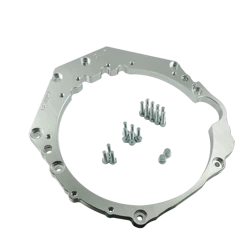
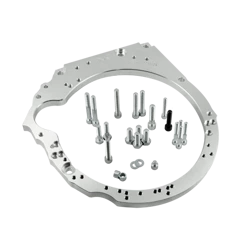
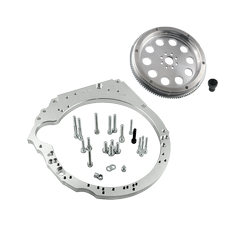
- Adapter Plate — Adapter plates typically around 20–25 mm thick. Polish solutions have become the global standard in recent years, ensuring the highest connection rigidity.
- Flex Plate — A specialized flywheel with a starter ring gear, dedicated to working with the 8HP torque converter.
- Pilot Reducer — A critical centering element that seats the converter pilot into the crankshaft. Without it, concentricity is unattainable.
- Coolant Adapters — Note that transmissions from Challenger/Charger models do not have threaded cooling ports and require adapters with O-ring seals and locking clamps.
- Mounts — Adjustable engine/transmission mounts (e.g., "Ultraflex" type), allowing for precise adjustment of the driveshaft angle relative to the differential.
03Concentricity and Converter Pilot — The Most Critical 5 Minutes
The most common cause of failure after a swap is the lack of concentricity between the engine shaft and the transmission's internal oil pump. The converter pilot must be seated perfectly centered and flat in the pilot hole. Any radial or axial runout is transferred directly to the crescent pump located behind the converter housing. This results in premature wear of the pump and the needle bearings supporting the converter, eventually leading to a drop in line pressure and burnt clutch packs.
1. Before mounting the transmission: Manually slide the converter into the transmission and ensure it "clicks" into all three stages (pump, clutch, turbine). The converter must be recessed about 12–15 mm from the face of the housing.
2. Lubricate the converter pilot with a thin layer of assembly grease or clean ATF oil.
3. Slide the transmission onto the adapter without forcing it — with correct alignment, the pilot should enter the reduction sleeve on its own.
4. Check with a dial indicator: The radial runout of the pilot in the sleeve must be within the range of ≤ 0.05 mm. If it's higher, find the cause (crooked adapter, wrong sleeve, inaccurate engine bellhousing machining).
A correctly executed mechanical 8HP swap is a process where there is no room for error. Precisely aligning the converter pilot with the crankshaft is the most important 5 minutes in the entire car-building process. If you mess this up, no electronics will save your transmission.
04Temperature Management in the 8HP Transmission
In sporting conditions (drifting, track racing), ATF oil temperature rises rapidly. Stabilizing oil viscosity is necessary to protect the seals.
Stock ZF 8HP cooling systems are designed to optimize emissions and reach operating temperature quickly to reduce internal friction. However, under high-slip conditions (drifting) or sustained heavy load (drag racing, towing), ATF temperature spikes instantly, leading to overheating and triggering "Limp mode."
Factory systems use bypass valves that often open too late or restrict flow in critical states. Aftermarket solutions, such as Sure-Cool kits or HPR adapters, work by completely eliminating the factory thermostat:
- 100% Flow — Forces constant oil flow through the external cooler from the moment the engine starts.
- Clutch Protection — Constant cooling effectively protects seals and friction plates from thermal degradation.
- Swivel Adapters — In custom projects, using HPR swivel adapters is recommended to facilitate hose routing in tight transmission tunnels.
- Viscosity Stabilization — Maintaining a stable temperature is crucial for the correctness of the precharge cycle adaptations and the stability of shift points.
The choice between a thermostat block and a full bypass depends on the climate and the vehicle's purpose — for street cars, a thermostat is essential to maintain operating temperature on cold days. In professional motorsport, high-efficiency coolers with forced air and real-time CAN bus monitoring are used.
05Choosing the Converter: Torque vs. Stall Speed
During a swap, choosing the right hydrodynamic converter from the ZF range determines the car's launch characteristics. It’s not just about "does it fit." The converter's stall speed determines whether the engine will build boost at the starting line or bog down during sudden acceleration. Of course, a converter can be modified and tailored to specific needs in a specialized workshop. This involves cutting it open, adjusting the internal vanes, and re-welding the unit.
- Street / Daily Applications — Standard converters from diesels or V8 engines are used, offering a low stall speed for smooth launches and good economy.
- Drag / Motorsport Applications — Converters from smaller gasoline units are often sought after, as they allow the engine to reach higher RPMs before full engagement, making it easier to build boost at the start.
06Emergency Release — Manual Park Lock Override System
In 8HP transmissions, the parking lock is controlled by a solenoid — no power means the transmission is locked in "Park." In swap projects, it is absolutely essential to install a mechanical release system using a cable. This is the only way to shift into neutral in emergency situations, which is critical for track safety and for getting the car onto a tow truck. Many ready-made kits are available online, consisting of an arm, cable, and lever.
If the 8HP loses power (electrical failure, accident, dead battery) without a mechanical emergency release system — the car is stationary. It cannot be winched or pushed. A cable or override bolt is an absolute necessity for every swap project.
07Shifters and Interior Ergonomics
Once the transmission is installed, it’s time to mount the shifter in the cabin. A popular solution in swaps is to use a factory shifter from a Dodge Challenger or BMW, allowing for OEM ergonomics while supporting sequential functions and paddle shifters. Through CAN bus integration, such a shifter "talks" to the controller, allowing full control over the transmission modes.
For those prioritizing maximum speed and control, sequential shifters are available, enabling gear changes like those in WRC rally cars. The 8HP can also be paired with various aftermarket and stock paddles, offering great freedom in how gears are selected.
088HP TCU Control Units
In advanced Performance Swap projects, the factory transmission control unit (TCU), integrated directly into the mechatronics inside the housing, poses a major barrier. The original ZF software is a closed ecosystem tied to OEM security protocols and restrictive limp-mode logic. This necessitates a choice between emulating CAN signals and physically bypassing the factory logic. The choice of an external TCU determines not only data transmission speed but also the ability to directly modulate solenoid duty cycles and precisely manage clutch engagement times.
Standalone TCU: Turbo Lamik and Direct Solenoid Control
Standalone systems, such as the Polish Turbo Lamik, are the top tier of "Direct Solenoid Control" solutions. They require a full replacement of the mechatronics' electronic layer, which is an invasive and irreversible process.
Installing a standalone system requires opening the transmission, removing the oil pan and filter to gain direct access to the solenoid control pins. The key element is the physical bypass of the factory controller. The original TCU processor is physically isolated, often by cutting it out of the mechatronics, and a dedicated PCB adapter board is soldered in its place. This board routes control signals directly to an external, universal TCU via a special connector (usually 26-pin).
Advantages of the Standalone Approach:
- Elimination of Limiters — Allows for the complete removal of factory torque limiters that might otherwise restrict engine performance.
- Direct Pressure Control — The engineer has full control over line pressure maps without the risk of mechatronic protection algorithms interfering.
- Performance Functions — Enables the implementation of features like Transbrake or Virtual Clutch, which are unavailable in stock software.
Firmware-based Solutions: CanTCU and MaxxECU
CAN protocol-based solutions operate at the logic layer communication level. Instead of physical soldering and hardware modification, an external controller (or a correctly configured engine ECU) emulates the data frames required by the factory ZF controller to release locks and execute shifts. The technician maps the correct values so the transmission controller sees all engine parameters passed by the ECU.
The primary benefit of this approach is maintaining mechatronic integrity. This system relies on the factory precharge cycle adaptation. The TCM precisely calibrates the pressure and duration of the rapid fill, maintaining ideal clutch clearance — the plates "touch" but do not yet transmit torque. The limitation is that attempting to force parameters outside the factory safety range can result in errors or forced limp mode.
TCU Systems Comparison
| Parameter / Function | Standalone (Turbo Lamik) | CAN-based (CanTCU / MaxxECU) |
|---|---|---|
| Control Method | Direct Solenoid Control | CAN Frames / OEM Protocol |
| Installation Difficulty | High (Internal access, soldering) | Low (Plug & Play) |
| Mechatronic Interference | Yes — Irreversible | No — Mechatronics intact |
| Transbrake | Full Support (P2/P3/P4 locking) | Depends on OEM firmware |
| Virtual Clutch | Yes — Manual modulation | Limited / Emulated |
| Thermal Management | Requires external sensors | Reads factory TFT (Fluid Temp) |
| Engines without CAN | Yes | No — Requires CAN bus |
| Recommended Use | Drag / Drift / Retro-Swap | Daily / Track Day / Modern Swap |
09Performance Features: Transbrake, Virtual Clutch, and Cut & Blip
For professional motorsport, the choice of TCU determines access to functions that decide milliseconds at the start line or the angle of a drift entry.
Transbrake — Static Extreme
The Transbrake function forces the simultaneous engagement of forward and reverse clutch packs. From a durability standpoint, this generates maximum static load on the planetary gearsets (especially the P2/P3/P4 satellites and carriers) and shafts. Using a Standalone controller allows for an instant pressure drop from the brake valve, permitting a rocket-like start with a spooled turbo.
For regular drag racing with a Transbrake, you must use the 8HP90 or 8HP95 model. The static loads generated by simultaneous forward/reverse tension are enormous — an 8HP70 might withstand a few launches before the P2/P3 units fail. For the 8HP70, the Transbrake should be reserved only for "gentle" drag racing with engines under 750 Nm of torque.
Virtual Clutch — Clutch Kick Simulation
Used primarily in drifting to initiate a slide. In a standalone system, this is achieved through a sharp drop and return of the PWM duty cycle on the operating pressure solenoids. This simulates a mechanical disengagement and violent re-engagement of the drive, allowing for instant loss of rear-wheel traction at high torque.
Mechanical Protection: Cut & Blip Logic
Regardless of the chosen controller, the key to survival for friction plates under extreme load is the Cut & Blip mechanism:
- Cut Function (Upshift) — The TCU sends a torque reduction request to the engine ECU before the higher gear solenoid actually moves. A temporary ignition or fuel cut minimizes the thermal energy generated on the clutches during engagement.
- Blip Function (Downshift) — During downshifts, a throttle blip is necessary. It synchronizes the transmission input shaft speed with the new ratio, preventing rear-wheel lock-up and protecting the mechanical integrity of the system.
10Standalone Tuning and Calibration Methodology
Standalone calibration differs from modern graphical interfaces, relying instead on manual mapping of hexadecimal tables. The industry standard software is Tuner Pro.
Tuning Fundamentals:
- Binary Files (BIN) — Raw processor data — the base for every map modification.
- Definition Files (XDF) — The translation key that maps hex addresses to engineering units like bars, milliseconds, or RPM.
- Torque Calculation — In analog configurations (e.g., older diesels), precise torque planning based on TPS and RPM curves is critical. An error in this calculation results in insufficient clutch clamping pressure, leading to instant slip under load.
When choosing an 8HP controller, remember that direct PWM control offers the most power but requires an electronics surgeon. Poorly set pressure maps in a standalone system will burn your transmission faster than 1000 Nm of torque. The TCU is the operational brain; without it, the ZF 8HP’s mechanical potential remains untapped. Correct calibration is primarily about precise thermal and pressure management.
The choice of TCU architecture should stem from an analysis of the entire vehicle control system:
- For Extreme Projects (Drag/Drift/Retro-Swap) — Turbo Lamik is the only solution providing full hydraulic control on engines lacking a CAN bus. It allows for bypassing factory limitations and implementing Transbrake functions in high-power builds.
- For Modern Performance Projects (Daily/Track Day) — CanTCU or MaxxECU integration is optimal when based on modern units. It ensures the highest shift refinement by utilizing factory ZF adaptation algorithms while maintaining mechatronic safety.
11General Overhaul: When Stock Parts are Not Enough
During a major overhaul, sealing components such as the mechatronic plug socket, oil return insert, and sealing sleeve must be replaced. In projects with extreme torque (8HP70/90), it is worth considering switching to an aluminum oil pan, which drastically increases the housing's structural rigidity and reduces micro-flexing.
Is the transmission "working" but you have doubts about the seals and clutch plates? Here are signals it's time for a major inspection:
• Over 150,000 km mileage without a previous overhaul + a history of intense use.
• A dynamic oil change revealed a significant amount of metallic shavings on the filter magnets.
• Precharge adaptations fall outside normal ranges — a sign of clutch wear.
• You plan a significant power increase — perform the overhaul before, not after a failure.
12Advanced ZF 8HP Diagnostics
Understanding symptoms allows for intervention before a failure becomes catastrophic. Most problems are progressive — here is a complete diagnostic matrix:
| Technical Symptom | Potential Cause | Engineering Verification |
|---|---|---|
| Shudder/Vibration | Wear of the lock-up clutch in the converter | Real-time analysis of converter slip (CAN) |
| 2→1 Jerk | Excessive play in the driveshaft flex disc | Inspect for cracks and axial play in the couplings |
| Hunting | Contamination of EDS regulators or incorrect ATF level | System flush (dynamic change) and Precharge adaptation |
| Error 4E86 | Software logic mismatch with hardware | Controller coding procedure — not a parts replacement |
| No Start | Incorrect mechatronic position sensor installation | Reinstall using guide pins |
| Limp Mode | ATF Overheating — insufficient cooling | HPR thermostatic adapter or Sure-Cool bypass |
None of the above symptoms appear suddenly. Every problem begins with subtle signals — minor jerks, momentary delays, or minimal vibrations. Regular diagnostics and service are the only way to catch faults before they become catastrophic.
13Builder’s Checklist — Final Verification Before Startup
A correctly executed 8HP swap is a process where every step is documented and verified. Use the following checklist before the first startup:
| Category | Checkpoint |
|---|---|
| ✅ Mechanical | High-quality adaptation flange + torque converter adapter |
| ✅ Mechanical | Converter pilot centered in the reduction sleeve with "3 clicks" seated |
| ✅ Mechanical | Driveshaft angles set with adjustable mounts (<3°) |
| ✅ Mechanical | Flex plate checked for micro-cracks |
| ✅ Cooling | Push-in adapters with O-ring seals + locking clamps installed |
| ✅ Cooling | Choice: HPR thermostat (street) or Sure-Cool full bypass (track/drag) |
| ✅ Cooling | Initial ATF level — topped up before startup |
| ✅ Safety | Emergency "P" mode release cable routed to the cabin |
| ✅ Electronics | TCU Controller: standalone or CAN — connected and pre-configured |
| ✅ Electronics | Startup: gentle drive, monitoring via CAN |
| ✅ Electronics | Precharge adaptation performed after the first oil change (35°C) |
| ✅ Documentation | Transmission configuration saved, photographic documentation of assembly |
14Series Summary — Key Rules for Every 8HP Owner
The ZF 8HP transmission is a technological monolith that has dominated modern drivetrain engineering. Thanks to the capabilities of standalone controllers and swap engineering, the 8HP has become the new standard in professional tuning, offering repeatability and speed that no manual drivetrain can provide.
In previous installments, we covered ZF 8HP service, tuning, and diagnostics. If you are planning a swap or need parts — visit our shop.