


Add products by adding codes
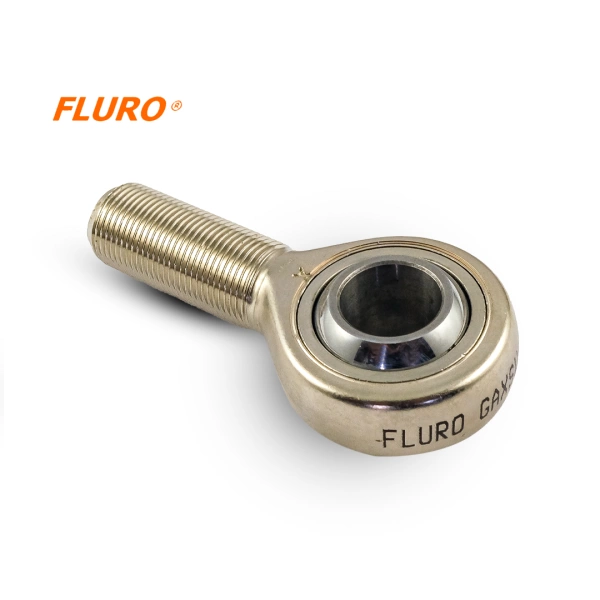
Rod end FLURO GAXSW 16 – M16 male, right-hand, heavy-duty, maintenance-free PTFE
- Heavy-duty rod end FLURO GAXSW 16: M16x2 right-hand male thread, 16 mm bore, load capacity 67.0 kN static / 52.5 kN dynamic, PTFE liner. 1 pc.
FLURO GAXSW 16 Rod End – M16 Right-Hand Male Thread, 16 mm Bore, Heavy Duty, Maintenance-Free (PTFE)
FLURO GAXSW 16 is a heavy-duty, maintenance-free rod end (also referred to as a rose joint, heim joint, spherical rod end, or threaded uniball) featuring an M16 right-hand external (male) thread and a 16 mm ball bore diameter. It supports a static load of up to 67.0 kN and a dynamic load of up to 52.5 kN, and thanks to its steel / PTFE sliding contact surface, it requires no lubrication throughout its entire service life.
The GAXSW 16 rod end has the exact same dimensions as the standard GASW 16, but offers a higher static load rating: 67.0 kN instead of 32.0 kN. This difference comes from the housing forged from 42CrMo4 quenched and tempered steel.
This rod end belongs to the GAXSW series manufactured by the German company FLURO-Gelenklager GmbH, built to dimension series K in accordance with DIN ISO 12240-4. This series is a heavy-duty variant of the GASW series, engineered for high compressive and tensile loads, making it ideal for motorsport, mechanical engineering, and any application where a joint must compensate for misalignment and operate with zero play.
Key Specifications at a Glance
- Manufacturer: FLURO-Gelenklager GmbH (Germany)
- Manufacturer designation: GAXSW 16
- Type: external (male) thread rod end, heavy duty, maintenance-free
- Thread: M16 (2 mm pitch), right-hand
- Ball bore diameter: 16 mm
- Static load rating: 67.0 kN
- Dynamic load rating: 52.5 kN
- Sliding pair: steel / PTFE
- Standard: DIN ISO 12240-4, dimension series K
- Sold as: 1 piece
Technical Specifications – FLURO GAXSW 16
| Parameter | Value (Metric) | Value (Imperial) |
|---|---|---|
| Thread (G) | M16 male, right-hand | – |
| Ball bore diameter (d) | 16 mm | 0.63" |
| Outer head diameter (D) | 42 mm | 1.65" |
| Ball / inner ring width (W) | 21 mm | 0.83" |
| Housing / outer ring width (T) | 15 mm | 0.59" |
| Center of bore to end of shank (L) | 66 mm | 2.60" |
| Overall length | 87 mm | 3.43" |
| Thread length (GM) | 40 mm | 1.57" |
| Tilt angle | 15° in each direction (30° total) | – |
| Maximum static load (C0) | 67.0 kN | 15062 lbf |
| Maximum dynamic load (C) | 52.5 kN | 11802 lbf |
| Limiting rotational speed | 230 rpm | 230 rpm |
| Weight | 189 g | 0.42 lb |
| Lubrication | maintenance-free – do not lubricate | – |


Construction and Materials
Housing (body with threaded shank)
The housing is forged from 42CrMo4 (AISI 4140) quenched and tempered steel and zinc-plated for corrosion protection. All sizes in the GAXSW series feature housings manufactured in this manner, which accounts for their increased static load capacity.
Race (bearing liner)
The race is made of free-cutting steel with a bonded PTFE sliding liner. This layer ensures maintenance-free operation of the joint with zero backlash.
Ball (inner ring)
The ball is manufactured from 100Cr6 (AISI 52100) bearing steel – hardened, ground, and polished.
Applications
GAXSW series rod ends are used in linkages that transmit axial forces along the rod while accommodating angular misalignment. Typical applications for the M16 size include:
- reaction rods and control arms,
- sway bar end links (anti-roll bar drop links),
- adjustable suspension rods and links (subject to load verification),
- adjustable tie rods and braces in tubular chassis structures,
- aerodynamic element mounts (splitters, wings),
- joints in machinery, automation systems, and actuators.
Selecting a rod end for a specific joint must account for actual operating loads and an appropriate safety factor – this is the responsibility of the design engineer or installer.
Installation Guidelines
- A 16 mm (M16) bolt or pin passes through the ball bore.
- Secure the threaded shank using an M16 jam nut.
- The threaded shank should be engaged to a minimum depth of 1.5 times the thread diameter, i.e., at least 24 mm.
- The rod end is designed for oscillating movements; full rotations are recommended only briefly.
- Do not lubricate the rod end – grease and oil degrade the performance of the PTFE liner.
- To utilize the full tilt angle, use conical misalignment spacers on both sides of the ball.
Frequently Asked Questions
What thread does the FLURO GAXSW 16 rod end have?
The FLURO GAXSW 16 rod end has an M16 external (male), right-hand thread. The thread length is 40 mm.
What bolt size fits the GAXSW 16 bore?
The ball bore diameter is 16 mm, so it accommodates an M16 (16 mm) bolt or pin.
What load can the FLURO GAXSW 16 handle?
The maximum static load rating is 67.0 kN (15062 lbf), and the dynamic load rating is 52.5 kN (11802 lbf).
Does the GAXSW 16 rod end require lubrication?
No. The rod end is maintenance-free – the race features a PTFE sliding liner that must not be lubricated. The rod end does not have a grease nipple.
What is the difference between GAXSW 16 and GALXSW 16?
GAXSW 16 has a right-hand thread, whereas GALXSW 16 has a left-hand thread. Using a pair of right-hand and left-hand rod ends on a single linkage rod allows you to adjust its length without disassembly.
What is the tilt angle of the GAXSW 16 rod end?
The ball tilts 15° in each direction, for a total of 30°.
What materials is the FLURO GAXSW 16 made of?
The housing is forged from 42CrMo4 (AISI 4140) quenched and tempered steel and zinc-plated, the race is free-cutting steel with a bonded PTFE layer, and the ball is hardened, ground, and polished 100Cr6 bearing steel.
What is the difference between GAXSW 16 and GASW 16?
GAXSW 16 is the heavy-duty version. It features a housing forged from 42CrMo4 steel and a static load rating of 67.0 kN, whereas the standard GASW 16 is rated at 32.0 kN. The dimensions, thread, and dynamic load rating of both versions are identical, making them directly interchangeable in terms of mounting.
Is the price for a single piece?
Yes, the price is for 1 piece of the FLURO GAXSW 16 rod end.